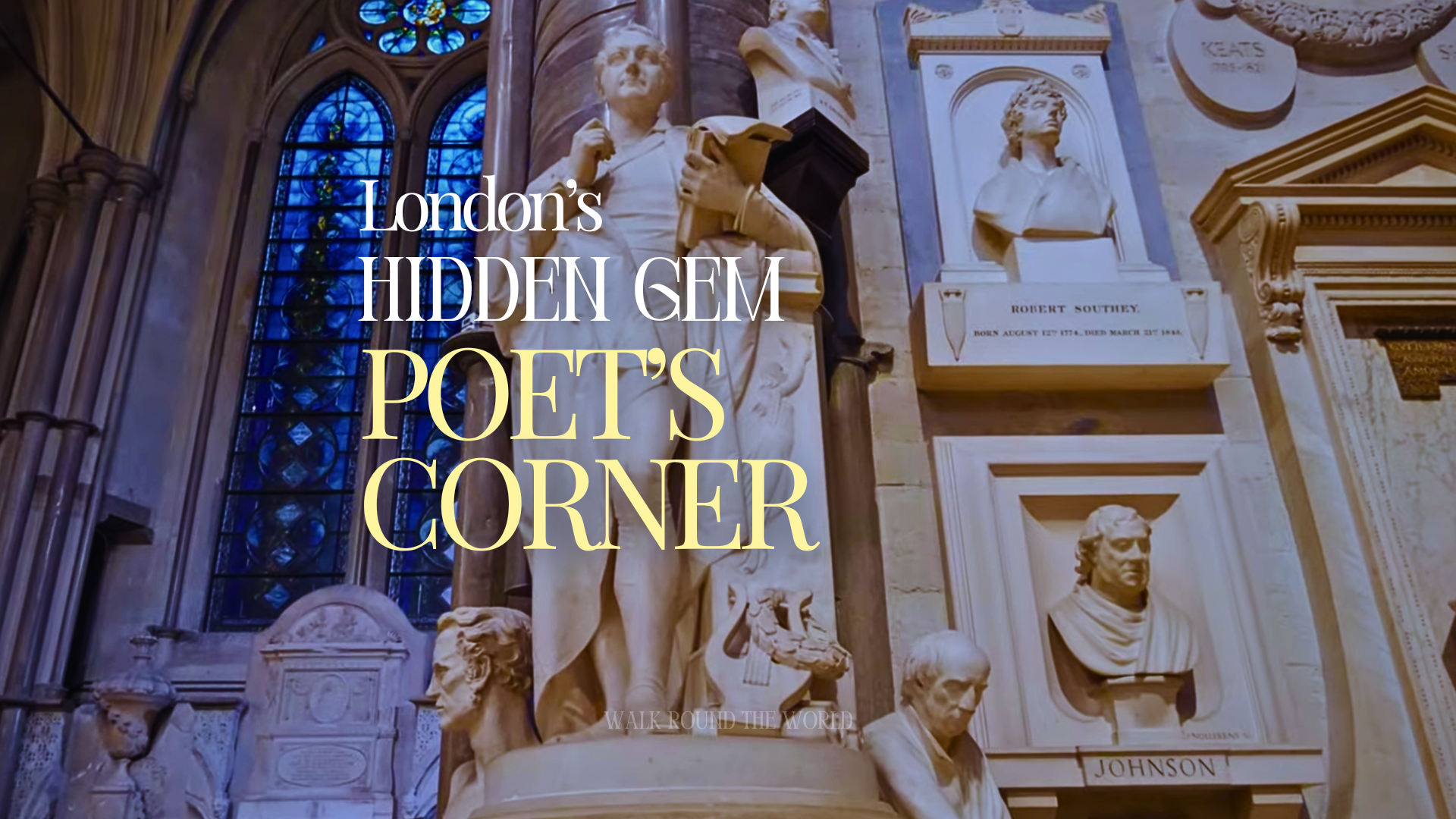
Is Westminster Abbey just a church to you? Or simply a must-visit in London?
Well, it’s actually far more than that.
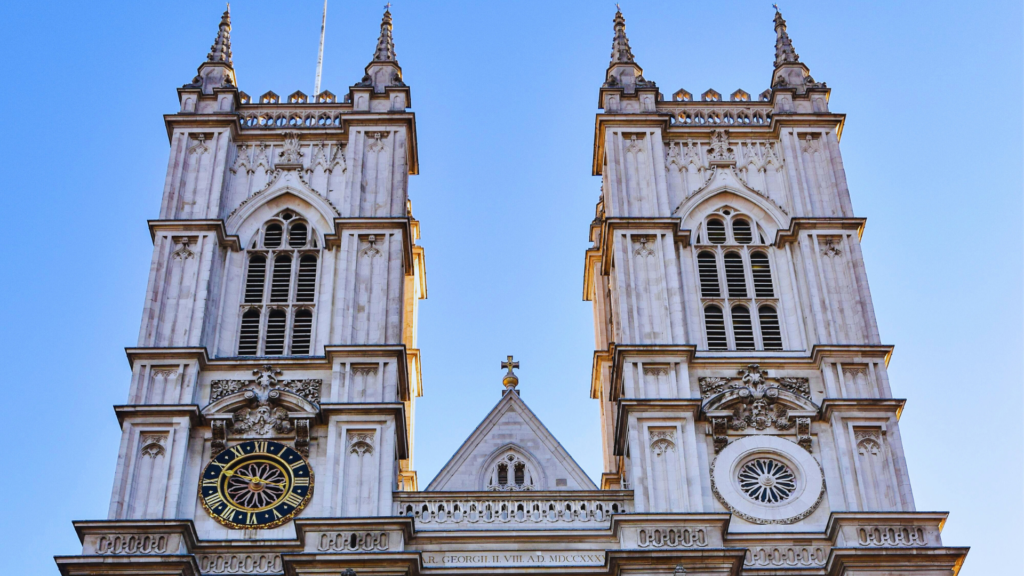
Apart from being one of the most famous and historically significant churches in England, this thousand-year-old abbey is a perfect blend of grandeur and mystery.
It’s where Queen Victoria’s coronation took place, and for hundreds of years, the kings and queens of England have been crowned beneath its grand vaulted ceilings. It’s the coronation church of England…. linked to the heart of the British monarchy.
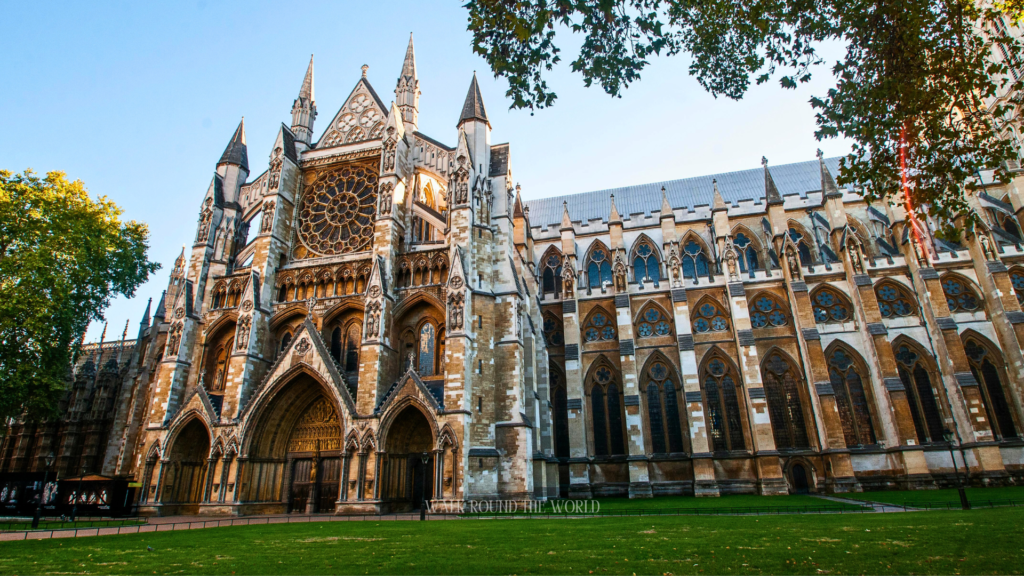
But is that all? Of course not.
Beyond royal ceremonies and state occasions, another legacy quietly unfolds within its walls. Westminster Abbey is also a living monument to Britain’s literary past.
Yes, the Abbey has a special corner.
The Poet’s Corner.
So, first, make your way to Westminster Abbey, located a few steps from Westminster Bridge and Big Ben. Then, inside the abbey, you will find this little corner. Tucked away in the South Transept of Westminster Abbey, just a stone’s throw from the main altar. Don’t worry, it’s not hard to find at all…after all, it is filled with tombs and memorials.
I agree, it isn’t that large… but none can deny the amount of cultural and literary significance this Westminster Abbey Poets Corner holds.
After all, not every day we get to feel the presence of literary legends like Chaucer, Dickens, Austen, and Wordsworth beyond the pages of books. Very rarely does one get to stand among the most celebrated writers buried in London, whose words shaped English literature.
So when you get the chance, why miss corner?
The Origins of Poet’s Corner
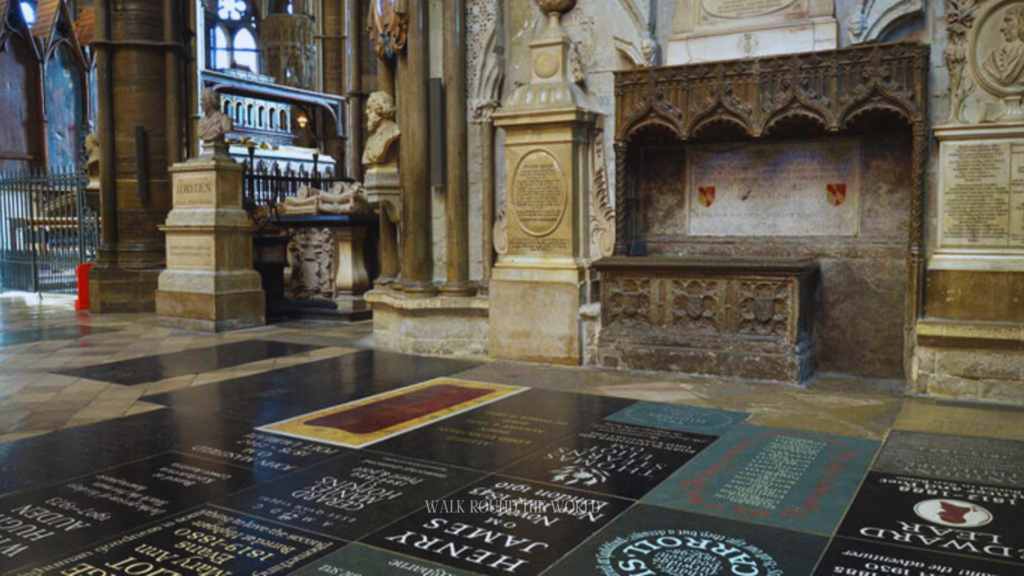
Do you know…the tradition of honoring writers in Westminster Abbey actually began by an accident?
Yes, it started with the burial of Geoffrey Chaucer, the father of English Literature and poetry.
But long before literary tradition began, the Abbey was already home to some of the most significant historic burials in London. Back then, Westminster Abbey served as the final resting place for monarchs, noble families, and high-ranking clergy rather than poets and writers.
Now the common question that would occur to anyone is….So, why is Chaucer buried in Westminster Abbey? Why did they make an exception for Chaucer?
Well, they didn’t.
The very first poet to be buried here wasn’t given the honor because of his literary brilliance, but because of his government position. Chaucer worked as Clerk of the King’s Works and happened to live within the Abbey precincts. Therefore, when he died in 1400, it was convenient to bury him near Westminster Abbey.
His grave was completely unmarked at first… until 150 years later, a fellow poet, Nicholas Brigham, commissioned for the ornate Chaucer Tomb South Transept.
Clearly, this sparked a trend…
In a way, the posthumous recognition of Chaucer as the “Father of English Poetry” turned his grave into the foundation of this Poet’s Corner. From then on, the practice of honoring poets, playwrights, and writers here continued.
Today, this literary corner stands as one of the reasons to visit Westminster Abbey.
So, who are buried in the Westminster Abbey Poets Corner?
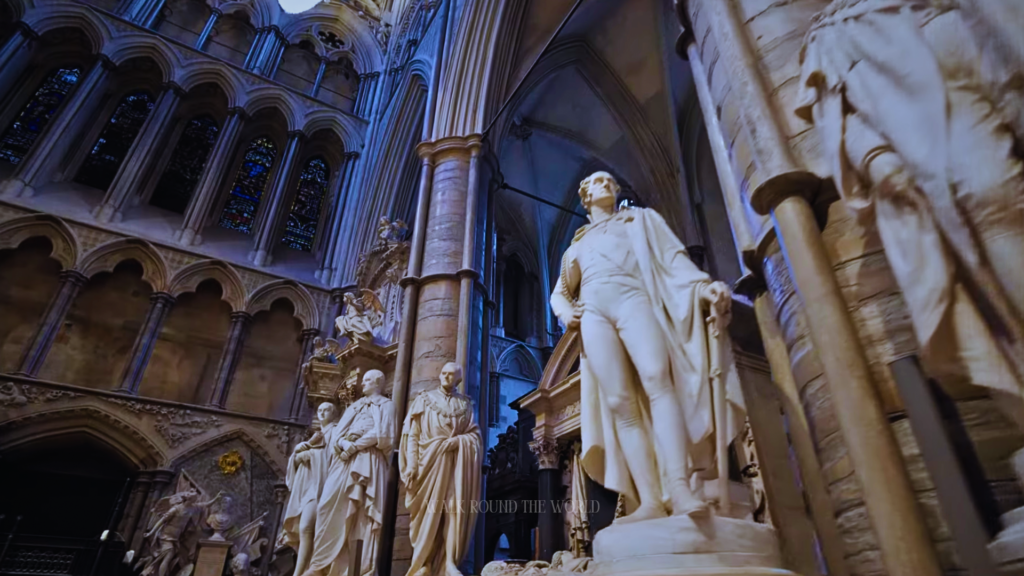
Image credit: Westminster Abbey (official YouTube channel)
Well, let me give you a quick Westminster Abbey Burials Guide.
There are over 100 literary figures memorialized in Poets’ Corner, though only about 50 are actually buried here. The rest have plaques or statues in their honour but are interred elsewhere.
Famous Writers Buried in Poets Corner
Though the tradition of Poet’s Corner started with Chaucer, the next literary burial came more than a century later in 1599. It was Edmund Spenser, the man behind ‘The Faerie Queene‘.
You know, some say that his unpublished works still rest beneath the stone sealed away forever.
Even legend has it… mourning poets of the time gathered around his tomb, slipping their own verses into his grave as an offering.
What an eerie offering! I just hope none of them got a reply from the grave.
Anyway, the tradition of this corner went on…
In 1637, Playwright and poet Ben Jonson was laid to rest here.
Then, in 1700, came dramatic opera writer John Dryden…
In 1721, it was British poet and diplomat Matthew Prior’s turn…
The creator of the first comprehensive English dictionary, Dr. Samuel Johnson, joined them in 1784.
…and so, it continued.
You know, in 1870, when English novelist Charles Dickens died, all he wanted was a quiet burial. But it was the public demand that brought him to this Poet’ s Corner.
Also, surprisingly, in the case of Thomas Hardy in 1928, his ashes were interred here…but his heart was buried in Dorset.
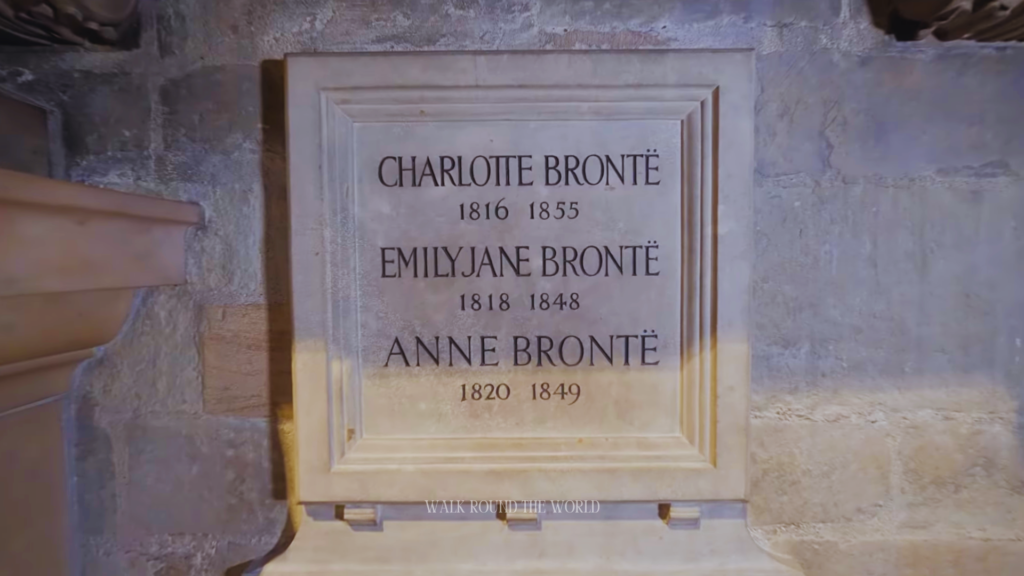
Other than them, today, you can also see the burials of Rudyard Kipling, Richard Brinsley Sheridan, Lord Tennyson, Robert Browning, along with many others, including actors and historians who have also found their final resting place within the Poets Corner Westminster Abbey.
This scale of Westminster Abbey burials makes it one of the most historically significant churches in Europe.
Now the question comes…
Is Shakespeare buried in Westminster Abbey?
Ah, sorry to disappoint you.
The most famous writer in the English language is not buried here. Instead, he rests far away from this abbey…beneath the Holy Trinity Church in Stratford-upon-Avon. All you can find here is the Shakespeare Memorial at Westminster Abbey.
Why so?
Well, it’s because of the time when he died.
In 1616, Poet’s Corner wasn’t yet an established tradition. It didn’t fully take shape until the 18th century. At that time, Westminster Abbey was still a place for royalty, noblemen, and high-ranking clergy, not playwrights.
And, back then, Shakespeare was still seen as a respected playwright and wealthy businessman.
So, by the time literary burial in the Abbey became a tradition, it was too late… Shakespeare had been resting in Stratford for over 100 years, and moving his remains would have been considered disrespectful.
So, Shakespeare remains in his hometown, Stratford-upon-Avon.
But, Shakespeare was too important to be left out entirely.
The Shakespeare Memorial Westminster Abbey
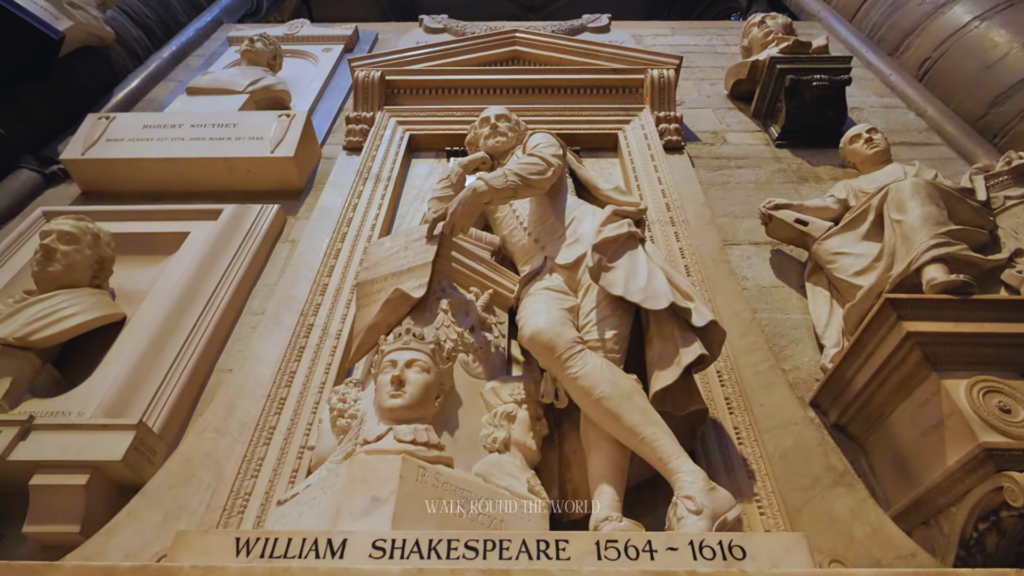
In 1740, over 120 years after his death, a large statue of Shakespeare was added in the Poet’s Corner in honor of his contributions to English literature. Through this grand marble Shakespeare Memorial Westminster Abbey shows him leaning on a pile of books, with an inscription taken from The Tempest–
“The cloud-capp’d towers, the gorgeous palaces,
The solemn temples, the great globe itself,
Yea, all which it inherit, shall dissolve.”
So, you can say…
Even in death, Shakespeare remains uniquely untouchable. His body in Stratford, his words in Westminster, and his legacy everywhere.
Literary Memorials Without Burials
Let me break the news upfront…. Just like Shakespeare…Jane Austen, Lord Byron, John Keats, Percy Bysshe Shelley, T.S. Eliot, Ted Hughes, and Philip Larkin are not here.
In the Poet’s Corner, these names remain among the most important literary memorials in London, even if their bodies rest elsewhere.
In case of Jane Austen… she did not achieve widespread fame during her lifetime, when she died in 1817. Her novels, including Pride and Prejudice and Sense and Sensibility, gained immense popularity long after her death.
But the rebellious Romantic poet Byron was denied burial in Westminster Abbey when he died in 1824. I believe it is due to his controversial reputation and life of scandal…Actually, Byron never cared for the rules of society, and even in death, it took 145 years for Westminster Abbey to welcome him….
145 years is a long time. Long enough for Byron to be reborn twice!
Now, it seems his epitaph rightly states,
“But there is that within me which shall tire,
Torture and time, and breathe when I expire.”
But, what about Keats and P.B.Shelly?
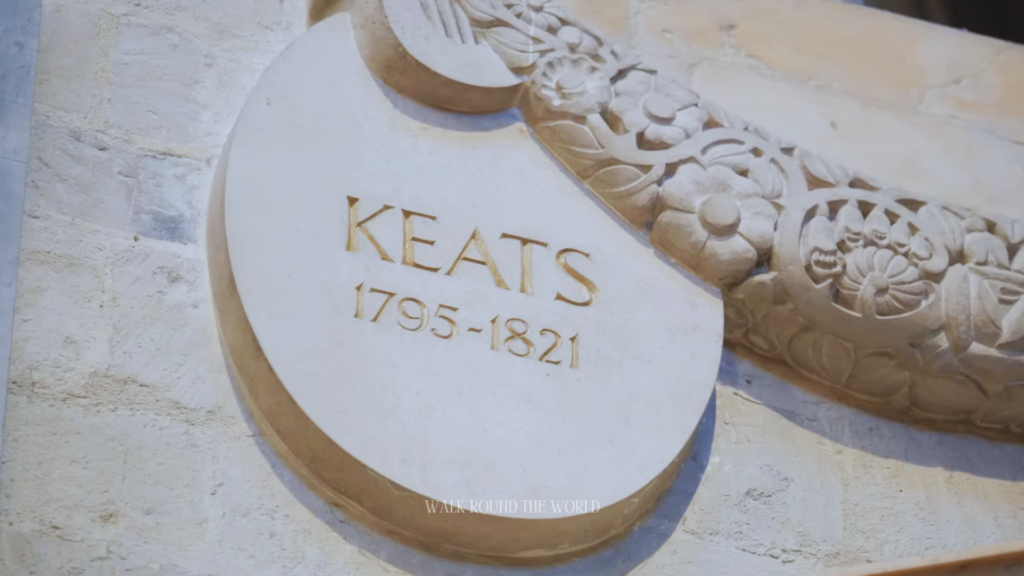
Well, these two Romantic poets died young and far from England. Keats died of tuberculosis at just 25 years old in Rome, and Shelley drowned in a shipwreck off the coast of Italy at 29 years old. Even though they rest beneath the Italian sun, the Poet’s Corner has brought them close to the heart of England.
Now to ensure that you don’t miss these tombs and memorials… I think you should consider a guided Westminster Abbey tour .
Also, you should know… It’s very likely that you won’t find your favorite writer or artist here. But let me tell you, the tradition of memorializing great writers in Poets’ Corner continues even to this day.
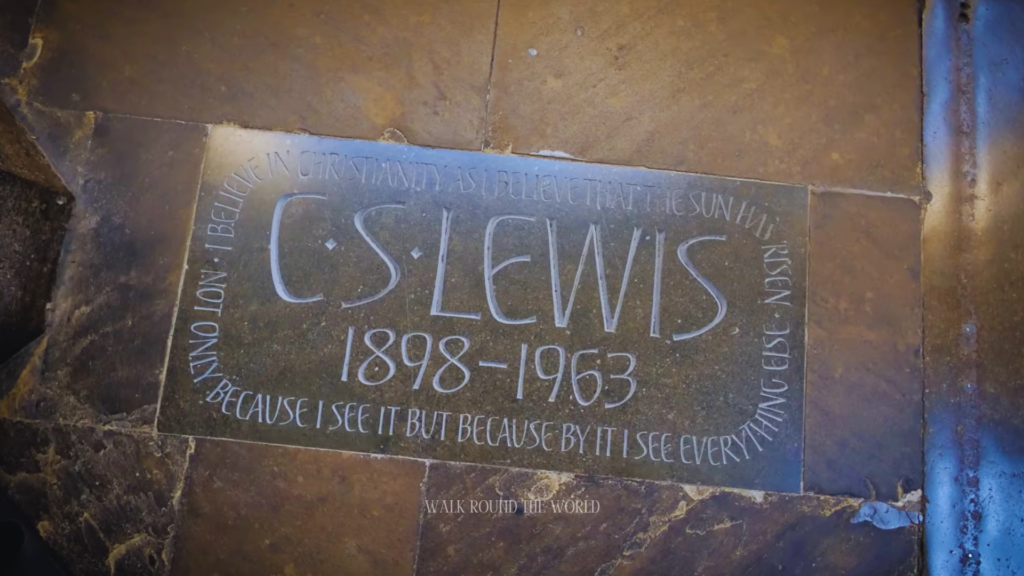
One of the more recent literary names associated with this Corner is C.S. Lewis. Though he is not buried inside Westminster Abbey, a memorial stone was dedicated to him in 2013 to mark the 50th anniversary of his death. The author of The Chronicles of Narnia is honored near other literary greats, symbolizing how Poets’ Corner continues to evolve with modern literary history.
Next comes… one of the most interesting part of the this blog…
What they rarely talk about.
Hidden Stories and Legends of Poets Corner
Ever heard about Ben Jonson?
Well, this famous English dramatist was buried standing up due to a lack of space. Maybe that’s why on his tombstone…one can find “O Rare Ben Jonson.”
And, who knows…maybe for this reason, there’s a rumour that some have seen a shadowy figure near Jonson’s burial site.
Is it possible that his restless spirit is still looking for a better resting spot?
Let me know in the comment below what you think.
Next, I would like to tell you another rumour… they say the graves of Dickens and Chaucer aren’t any less haunted. It is believed by many that on every death anniversary, Charles Dickens comes to visit his tomb, and close to Chaucer’s, it feels as if someone is reciting lines from The Canterbury Tales.
Of course, the Abbey officially denies these stories.
But what couldn’t be denied so easily were those rumors about unexplained chills near certain Famous Graves Westminster Abbey.
So, it’s true that when you are in that Poet’s Corner, you will feel these literary elites’ presence in one way or another. This really makes this hidden corner worth visiting atleast once I believe.
And before I leave…
Westminster Abbey Royal Burials
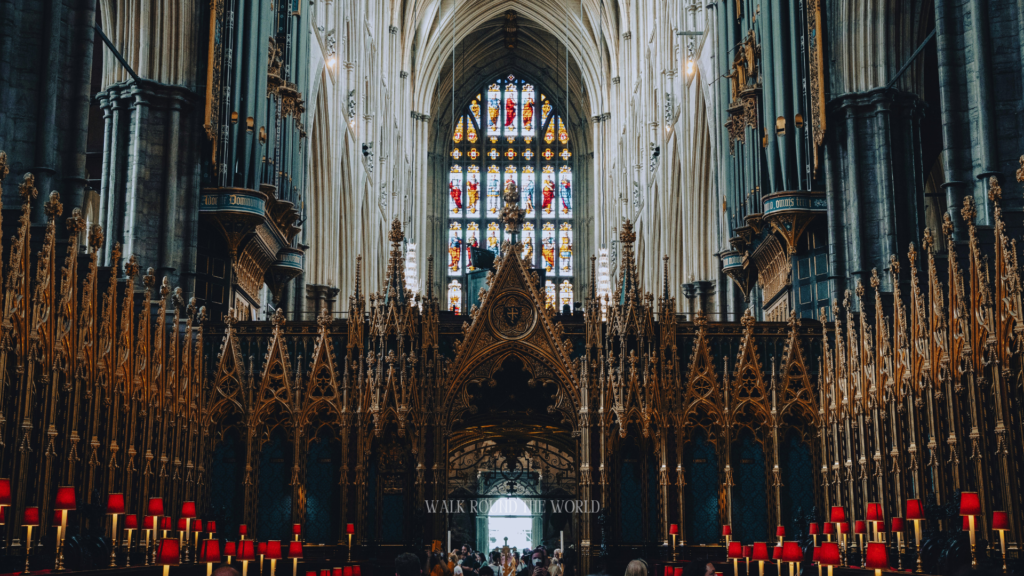
Of course, Poets’ Corner is only one chapter of the Abbey’s story.
But, there’s more.
You already know about the famous Westminster Abbey Royal Burials…there are not just any royals, even monarchs, as in kings and queens, who are buried under this abbey.
Monarchs Buried in Westminster Abbey
The first royal burial in the Abbey started in 1066 with Edward the Confessor and continued till James VI & I in 1625. Among the monarchs buried in Westminster Abbey, you can find Elizabeth I, Mary, Queen of Scots, Henry III, Edward I …and many other significant historical figures.
Scientists Buried in Westminster Abbey
Beyond the royals, several great scientists are also buried here…
You can find Sir Isaac Newton. Right next to him, there are Charles Darwin and Stephen Hawking.
When you leave, you will realize that even in death, poets are alongside scientists, politicians, and respected royals. As they were in life.
So if the Natural History Museum in London preserves it in fossils and discoveries, then the Westminster Abbey preserves Britain’s literary and scientific legacy in stone.
So, try not to miss this little corner while in the Abbey.
If you plan to visit Westminster Abbey London, allow at least two hours to explore the interior fully. And if you’re planning to explore more of London’s stories, don’t miss…the charming tale of Paddington Bear at Paddington Station.
I intend to share more interesting stories with you all. So, keep an eye out for my upcoming blogs.
Bye for now!
FAQ
What to see inside Westminster Abbey?
There is far more to see inside Westminster Abbey than just Poets’ Corner. Key highlights include:
1. Poets’ Corner
2. The Coronation Chair
3. Royal Tombs
4. Henry VII’s Lady Chapel
5. Scientists’ Graves
6. The High Altar & Nave
7. The Pyx Chamber
Who is buried in Poets Corner?
Among those buried in Poets’ Corner in Westminster Abbey are Geoffrey Chaucer, Edmund Spenser, Ben Jonson, John Dryden, Samuel Johnson, Charles Dickens, Alfred Lord Tennyson, Rudyard Kipling, and Thomas Hardy. Many other famous writers, such as Jane Austen and Lord Byron, are commemorated here but buried elsewhere.
How many people are buried in Westminster Abbey?
More than 3,000 people are buried inside Westminster Abbey, making it one of the most significant burial sites in the United Kingdom. These include-
- Monarchs and royal family members
- Prime ministers and politicians
- Scientists and philosophers
- Poets, playwrights, and novelists
- Military leaders and national figures
Why is it called poets Corner?
It is called Poets’ Corner because it became a dedicated space for honoring poets and literary figures, beginning with the burial of Geoffrey Chaucer in 1400. Interestingly, Chaucer was not buried there for his poetry, but over time, other writers were buried nearby, and the area in the South Transept gradually became known as Poets’ Corner. Today, it represents over 600 years of English literary heritage.
What to See Near Westminster Abbey?
Westminster Abbey is located in one of London’s most historic and walkable areas. After your visit to the Abbey, explore these nearby attractions such as Palace of Westminster, Big Ben London, Parliament Square, Westminster Bridge, and Churchill War Rooms.
Leave a Reply