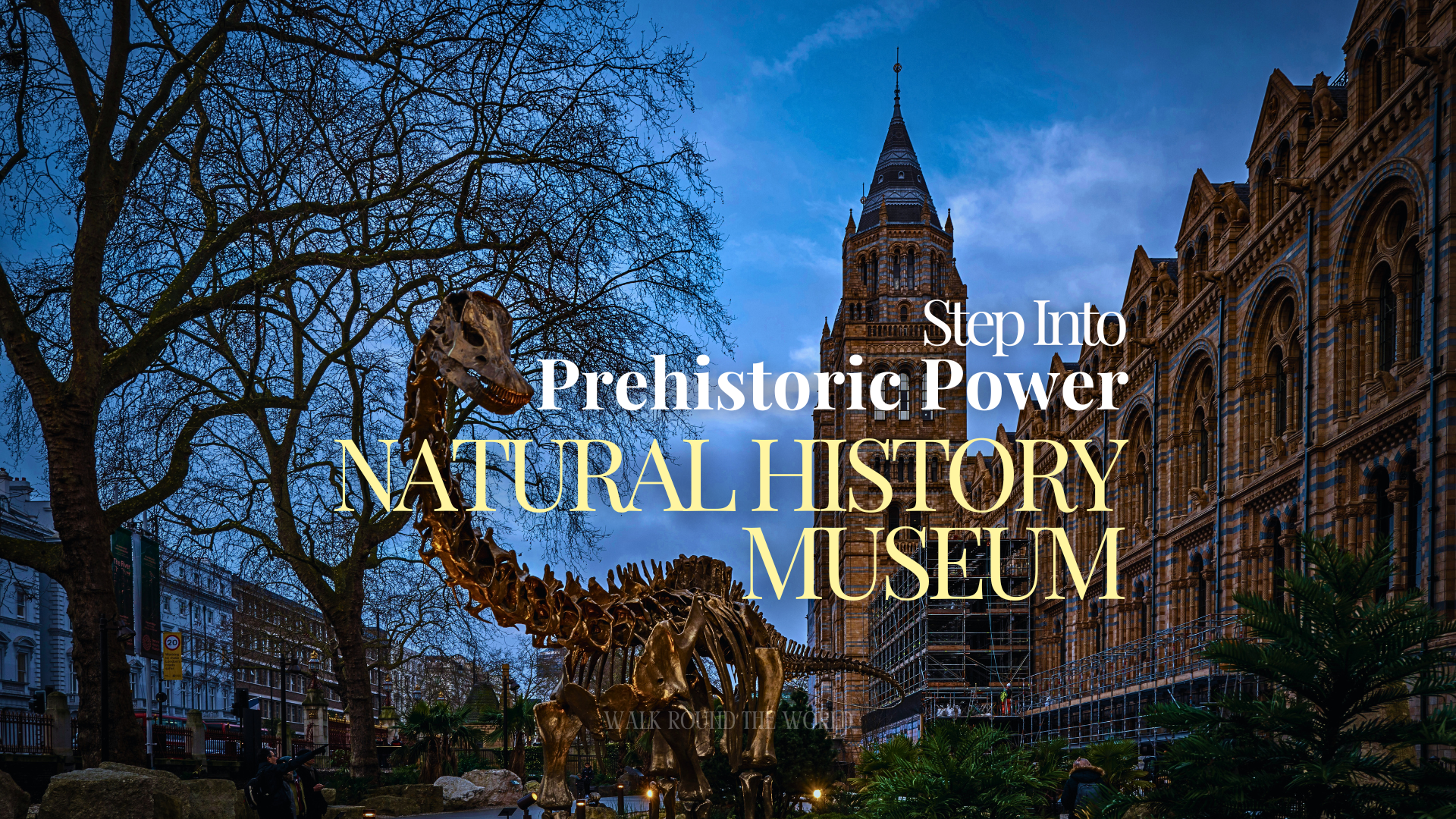
Have you ever come face-to-face with something so massive that it makes you feel as tiny as an ant? Or stood before something older than the Earth itself?
In London, that’s not just possible… but it’s an experience waiting for you.
Welcome to the Natural History Museum London… one of the most extraordinary places to explore in the UK capital.
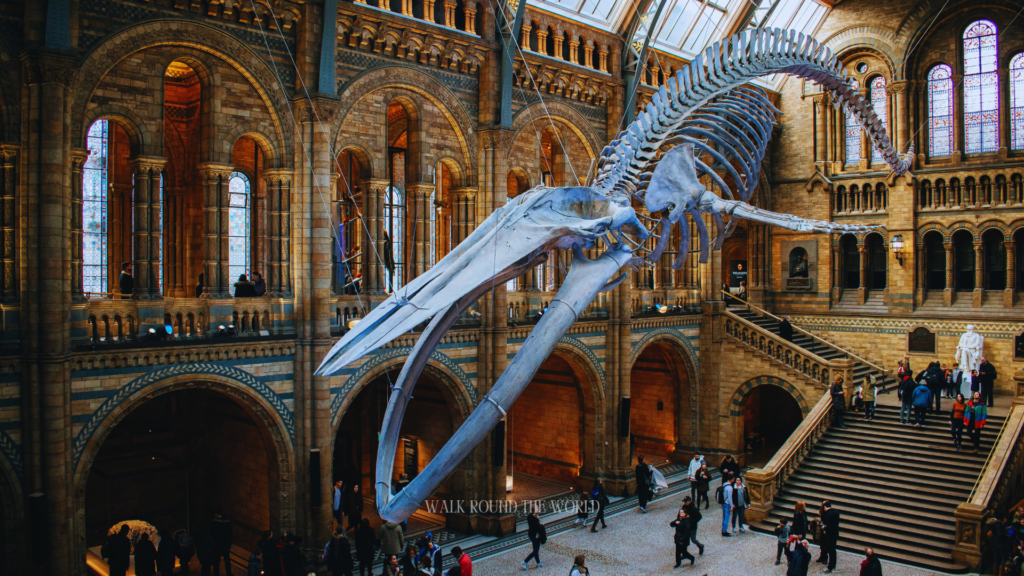
Here, one moment you’re standing in front of a dinosaur frozen in time, the next you’re craning your neck beneath an 82-foot blue whale skeleton that makes you feel wonderfully small. And just around the corner? Ancient meteorites that have seen more of the universe than we ever will.
It’s where nature’s greatest hits are all on display… and guess what?
It won’t cost you a thing. This is clearly one of the best reasons to visit Natural History Museum London, as entry is completely free. No catches.
So whether you’re on a solo adventure, dragging along your very curious (or very tired) kids, or just in search of some marvel-worthy rainy day activities in London…this is one stop you can’t skip.
Now, “with so much to see in this museum, where do I even begin?“
Glad you asked. That’s exactly what I’m here for.
So come on then. Let’s start.
A Brief History of the Museum
I know what you’re thinking… “Oh no, not a history lecture!“
Don’t worry, I am not in the mood to bore you with names and dates. But here’s something you should know…. “Why was this place built in the first place?“
Well, the answer is… to give nature its own space in London.
Before this museum existed, all the natural specimens were stuffed into the basement of the British Museum in Bloomsbury…buried there under mummies, and Greek antiquities.
Nature was, quite literally, downstairs.
Then came Sir Richard Owen, the anatomist and paleontologist who coined the term ‘dinosaur’. He believed natural history deserved a dedicated cathedral of science, and he fought tooth and claw for years to make it happen. Finally, in 1864, he won when the government agreed to create a separate Natural History Museum.
And thus began one of London’s most ambitious museum projects.
Construction kicked off in 1873, and the museum officially opened in 1881…though it wasn’t technically finished for the next few more years.
Finally, it separated from the British Museum in 1963, and since then, it has grown from 5 million specimens to over 80 million.
Yes, 80 million. Can you believe it?
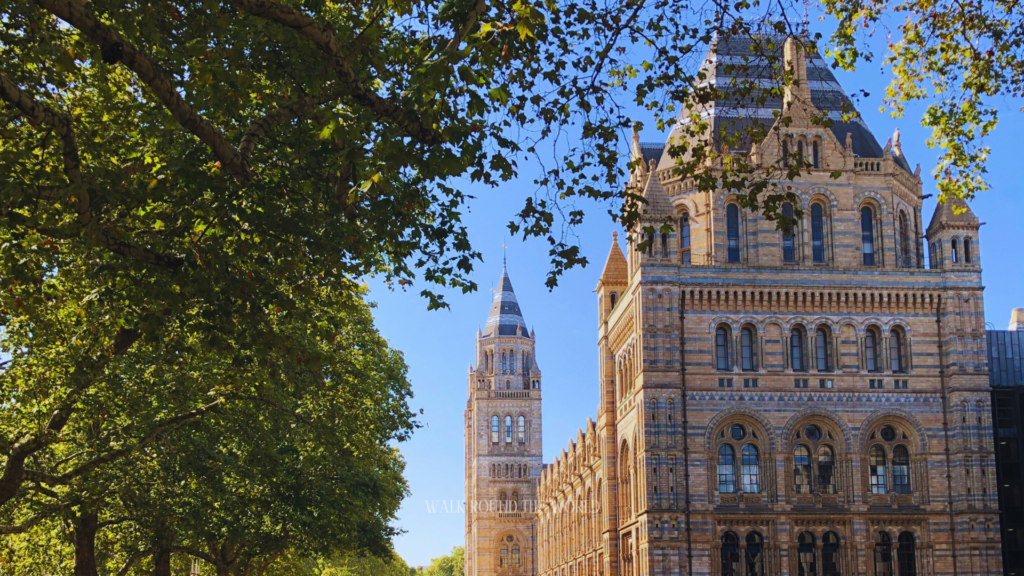
Now, come to the Architecture of the Natural History Museum London
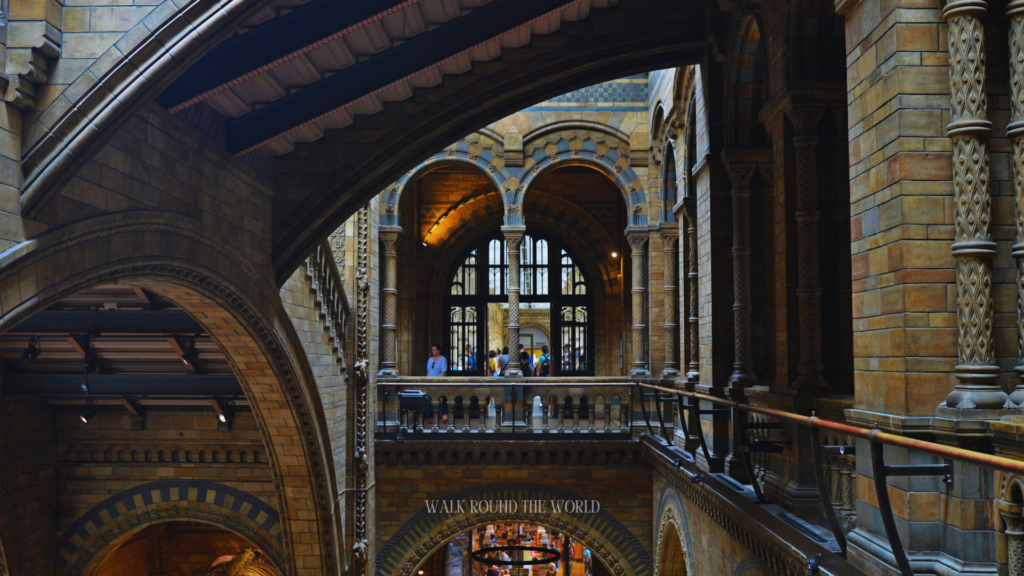
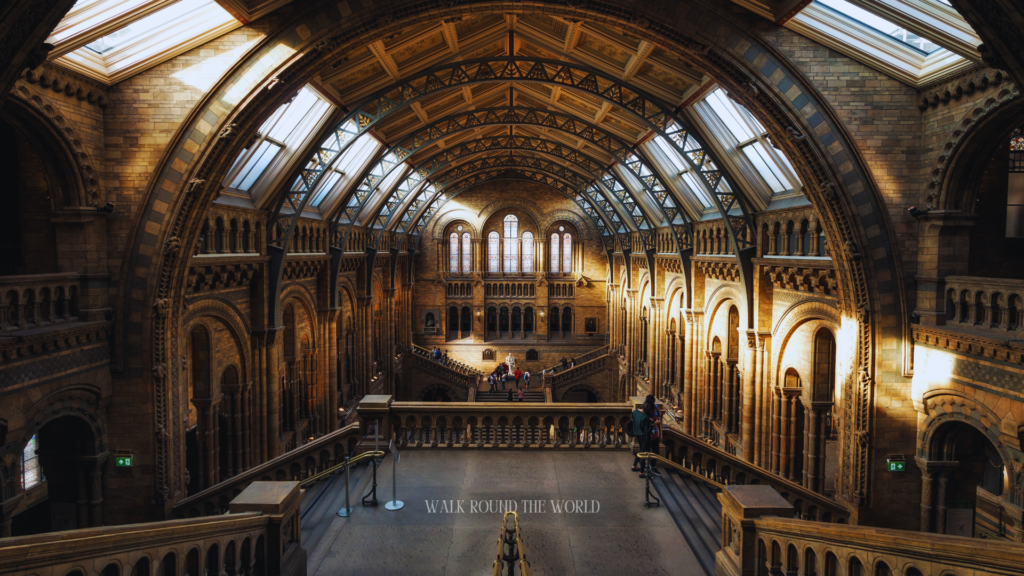
Here’s the bit you didn’t expect to fall in love with… the building itself.
The architecture of this dedicated museum is just as jaw-dropping and legendary as the dinosaurs inside.
Designed by Alfred Waterhouse
Just like Big Ben, a design competition was held to choose the architect for this grand museum of today’s. Alfred Waterhouse, a young architect known for his distinctive Romanesque Revival style, was chosen for the job. This last-minute dark horse was more into building a cathedral of natural science than a mere museum.
Mr. Waterhouse decided to model it after 12th-century Romanesque architecture, with influences from continental cathedrals featuring grand arches, columns, and vaulted ceilings to the museum.
Do you know that the museum was built using terracotta tiles? And, it wasn’t just for beauty, but because it resists London’s signature soot and smog. Practical and pretty. What do you say?
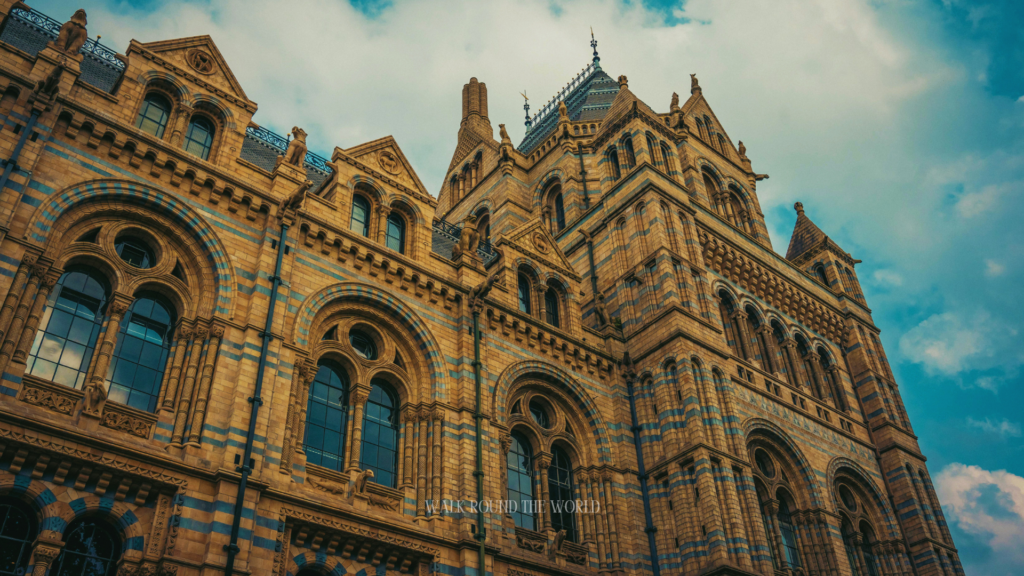
The best part about its architecture is that…it’s more of a storytelling. If you aren’t paying attention at 100%, you never know when you will miss those hidden creatures on the wall.
This is where the magic of Waterhouse design kicks in.
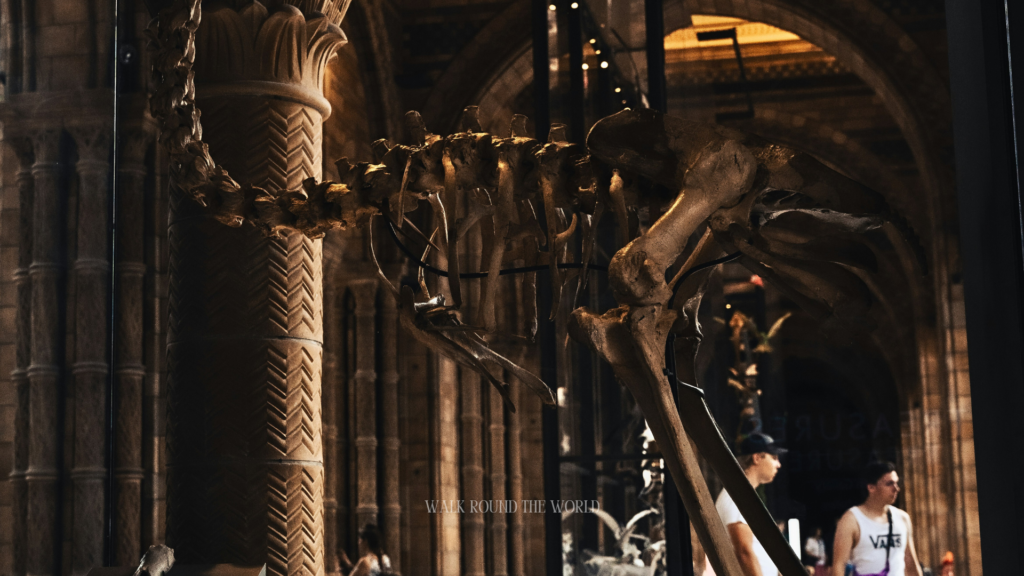
He filled the building’s façade and interiors with hundreds of animal carvings, all hand-sculpted in stone. There are extinct animals, real species, and mythical creatures… from frogs climbing pillars to apes peeking from arches.
On the west side of the museum, carvings focus on living creatures…while on the east, there are mostly extinct and fossilized species. If you look closely, you’ll find bats curled into column tops, lizards on stair rails. Even the floor tiles are themed…very intricately styled with leaves, vines, and ancient floral motifs.
Here, you must agree with me… It’s a living building.
No doubt, Waterhouse was a genius. He built a building that doesn’t just house nature… But it is nature.
Well, What To See Inside Natural History Museum London
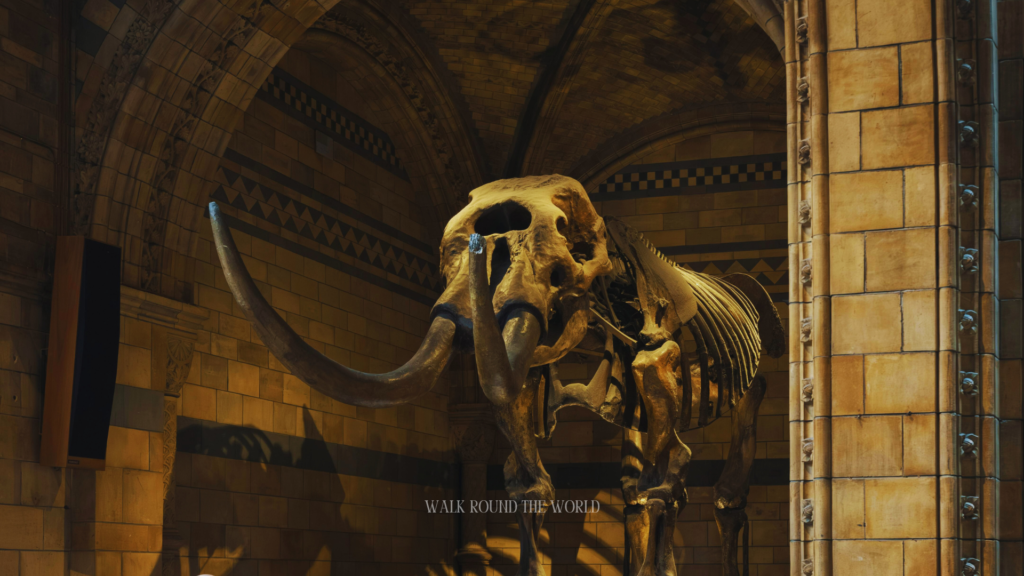
Honestly, where do I even begin?
If you’re specifically searching for a dinosaur museum in London, this is the place to be.
There are so many extraordinary things inside, that this place needs its own postcode, let alone a separate blog.
And that’s why, I bet this stop fits perfectly into anyone’s well-planned London museum itinerary. A museum you can’t say “No” to.
Now, let’s enter the building.
Hintze Hall and the Blue Whale Skeleton
First, you step into Hintze Hall (well, it’s the current name).
This entrance hall was the former home to “Dippy the Dinosaur”. However, in 2017, Dippy went on a UK tour, and now “Hope”, a real blue whale skeleton, floats above you… suspended in mid-air as if she’s still diving through time. Even this skeleton alone is so large that you’ll need to walk for several minutes to fully appreciate its scale.
Now, just beneath Hope, near the entrance, you’ll discover one of the world’s most complete Stegosaurus skeletons.
And right across from the staircase, there is none other than Charles Darwin… yes, he sits in this very hall. Who knows, perhaps he’s just observing the daily visitors to this museum.
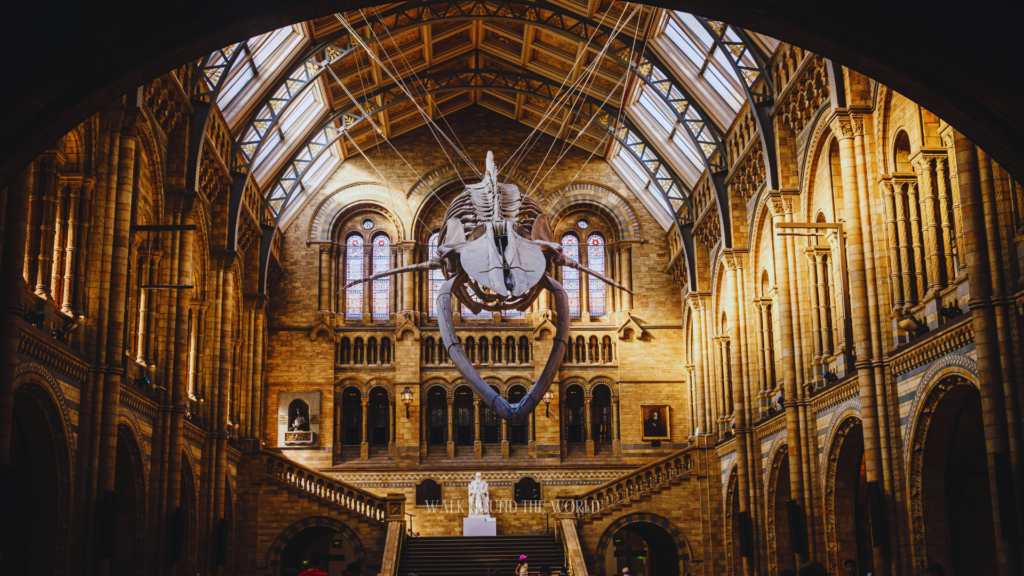
Anyway, while still in Hintze Hall, be sure not to miss the fascinating meteorites and displays of extinct reptiles just above those stairs.
Up on these balconies, there’s also a remarkable 2-meter-tall Fossil Tree Trunk, which is no less than 300 Million Years Old. They say it’s from a prehistoric rainforest….and belonged to a species that predates dinosaurs. Older than dinosaurs? Wow!
No wonder why it consistently ranks among the best museums in London.
Now, after Hintze Hall, you need to decide where you want to go next, depending on your interests. And for this you need a thorough Natural History Museum London travel guide.
Hence, A Quick How-Not-to-Get-Lost Guide
I personally believe this museum is more famous than the ones in Central London.
You can visit the British Museum, the National Art Gallery, the Victoria and Albert museum and all the other famous museums in London. But none quite match the charm of this particular one.
The museum is not just for dinosaur-loving kids, it has the potential to captivate even the adults. That’s why, no matter how packed your London itinerary may be, please make sure this place earns a spot. Otherwise, you will end up missing the dinosaurs, the famous blue whale skeleton, museum zones…so much.
By the way, the museum is divided into several distinct zones… Blue, Red, Green, and Orange. Each of them offers a completely different experience to visitors.
So, let’s talk about these Natural History Museum London zones for a while.
The Blue Zone
First, let me tell you where the dinosaurs are…they are here.
There’s actually a life-sized animatronic T. rex in this dinosaur gallery in London. It roars and moves in a dark jungle setup. So, if your kids ever seek the Jurassic Park experience, this is where you need to bring them.
After all, the blue zone dinosaurs London exhibit is one of the most popular sections for visitors of all ages.
Also, don’t forget to step into the land of giants.
This giant mammals hall of this zone includes the full-size model of a blue whale, mammoths, a giant ground sloth, and many more. This is some place where you will actually feel tiny. Your problems will feel even tinier.
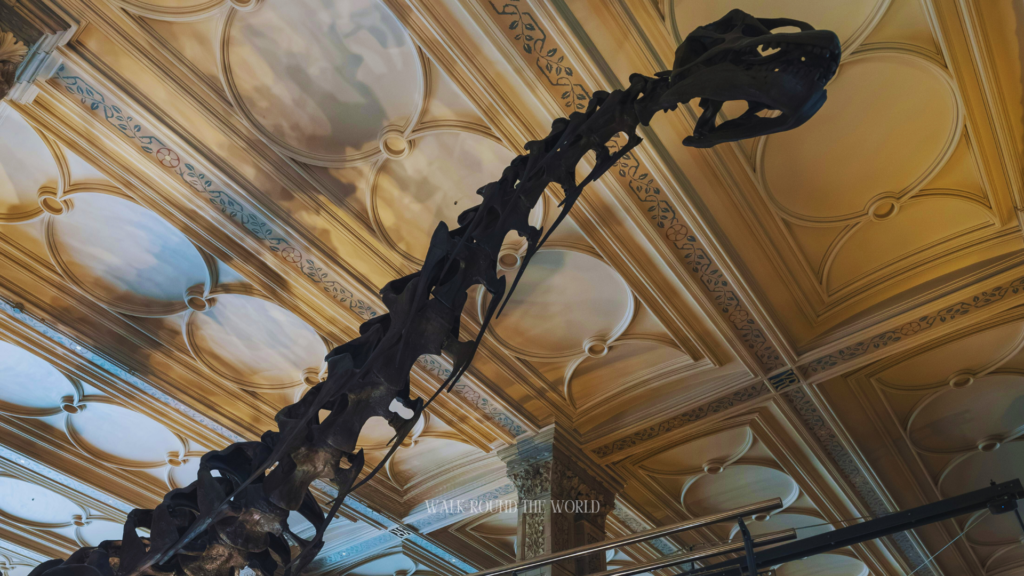
Now I know, why among all the free museums in London 2026, this one remains the most visited.
Perhaps, for its blue zone… What do you think?
Anyway, what’s next?
Human Evolution Gallery
Well, you need to see the Neanderthals and early humans.
For that, remember to visit the Human Evolution Gallery. Also, this is where a replica of Lucy is, though the real Lucy is in the national museum of Ethiopia. That 3.2-million-year-old ancestor of ours.
And, if you’re a fan of The Lord of the Rings, you’ll enjoy staring at those tiny Mystery skulls of human… “Homo floresiensis”.
When I saw those, I couldn’t help but wonder….How can a human skull be only about the size of an orange? Yes, they are that tiny. As per historians, it belongs to a human species that lived in Indonesia about 50,000 years ago.
Just like many others, I initially thought it was fake…or some kind of deformity. When it was found, some scientists also thought the same….until more skeletons were found. So, yeah, they are real… and they rewrote human history as we know it today.
The Red Zone
Now, let’s go to the red zone Natural History Museum.
I believe, this is your portal to the Earth Hall and geoscience zone…where you will see a real moon rock brought back from Apollo missions, the Aurora Pyramid of Hope, and, of course, you can experience a terrifyingly real earthquake simulation.
No matter what you skip here, don’t miss the Nakhla Meteorite.
Why? What’s so special about it?
Well, it’s one of the few meteorites known to have come from Mars… and it was rumored to have killed a dog when it landed in Egypt in 1911. (Though that’s possibly an urban legend).
What most people don’t know about it is…Scientists discovered amino acids in the rock, and this very rock was the reason that sparked decades of “life on Mars?” debate.
I missed it the first time too… partly because I didn’t know it existed, and partly because I didn’t have much time to figure out what I’d missed. So, don’t make my mistake. Whenever you visit the museum, make a list of the items you’re eager to see.
Now, do you want more?
The Green Zone
Well, there’s still a green zone.
It’s totally focused on Fossils, Minerals, and Treasures.
Here, you can come across those sea monsters that ruled this planet before the dinosaurs. Then in the Minerals Gallery, there are rows after rows of glittering stones, meteorites, and volcanic rocks.
By the way, here in this zone…there’s a treasures gallery, where there is the first edition of ‘On the Origin of Species‘ by Darwin.
Also, here you will find that 4.5 billion-year-old meteorite and an incredibly rare 2,000-year-old Dodo skeleton. We all know that Dodos went extinct around 1681, making them the first species we recorded as wiped out by humans. Now, doesn’t that make it worth seeing? Yes, of course.
The Orange Zone and Darwin Centre
And finally, there’s the orange zone with its Darwin Centre.
Ever heard about the Spirit Collection? This part of the museum is often missed by the casual visitors. If you forget about this section, you might miss over 8.5 meters long Archie the Giant Squid.
And that’s not all.
Honestly, I can keep talking…for another hour or more. Believe me, there’s still so much more to talk about, and more importantly, so many legends and stories to tell you all.
Don’t you wonder why London’s Paddington bear was so afraid of this Natural History Museum? Or where are they hiding that real Anaconda Skeleton? Or simply, why on earth are there so many pigeon skulls next to Darwin’s book?
These are the kinds of questions that naturally arise, and they all deserve answers.
That’s precisely why I believe the Natural History Museum of London warrants another dedicated article.
So, I’ll conclude this one here. Find me on my next London blog.
Until then, go, wander and wonder.
FAQ
Is the Natural History Museum of London Worth Visiting?
Yes, Definitely. The Natural History Museum is a must visit in London especially if you enjoy science, history, or architecture. With free entry, world-class exhibitions, and interactive galleries, the Natural History Museum isn’t just another stop on your London itinerary. It’s an experience. One that surprises both kids and adults in equal measure.
How long to spend at the Natural History Museum of London?
Most visitors spend around 3 to 4 hours exploring the main Natural History Museum zones, including the Blue Zone (dinosaurs), Red Zone (earth sciences), and Green Zone (fossils and minerals). But here’s the truth… if you’re curious, easily distracted by fossils, or visiting with kids, half a day disappears quickly. However, museum lovers could easily spend an entire day here and still feel like they’ve only scratched the surface.
What are the best things to see in the Natural History Museum?
Start with the 82-foot blue whale skeleton, “Hope,” suspended from the ceiling. Then there’s the dinosaur gallery. It is a must for its animatronic T. rex and impressive fossil displays. From there, head to the Red Zone which draws attention with its earthquake simulator and lunar rock. If rare specimens interest you, I would say look out for the ancient meteorite, the Dodo remains, and the Human Evolution gallery. Trust me, you will love them all.
What is the oldest thing in the Natural History Museum of London?
One of the oldest objects inside the Natural History Museum in London is a meteorite that is nearly as old as Earth itself. There’s also a 300-million-year-old fossil tree trunk and prehistoric specimens that predate dinosaurs. Standing in front of them, you will realize history can be interesting too.
Leave a Reply